

 Italiano
 English
AN INNOVATIVE GENETIC TEST TO IDENTIFY PREDISPOSITION TO PRODUCING EMBRYOS WITH ANEUPLOIDIES

Why talk about aneuploidies
Aneuploidies are numerical chromosome abnormalities: a cell may carry one extra chromosome (trisomy)
or one missing chromosome (monosomy) compared with the normal chromosomal complement. In
reproductive medicine, these abnormalities are among the most frequent causes of implantation failure, early
miscarriage, and, more rarely, ongoing pregnancies affected by a chromosomal abnormality up to birth.
A key aspect - often relevant for clinical assessment and for interpreting laboratory findings (including
PGT-A) - is that aneuploidy can have different biological origins, with different implications for
pathophysiology and risk.

Aneuploidies: meiotic origin vs mitotic origin
Aneuploidies of meiotic origin
These arise during meiosis, the process that leads to the formation of gametes (in particular, the oocyte). In humans, most meiotic aneuploidies are of maternal origin and show a well-known relationship with age; however, in addition to age, individual genetic factors may also contribute.
Aneuploidies of mitotic (post-zygotic) origin
These occur after fertilization, during the very first mitotic divisions of the embryo, due to chromosome segregation errors. Such errors may lead to:

embryonic mosaicism (the presence of cell lineages with different chromosomal complements within the same embryo);

complex patterns with multiple aneuploidies, sometimes associated with multipolar divisions.
Aneuploidy is not a "single" phenomenon. Understanding its origin (meiotic or mitotic) can help specialists better interpret specific clinical scenarios and certain patterns observed in ART pathways and PGT-A results.

WHAT IS FERTILADVANCE ANEUPLOIDY RISK
FERTILADVANCE ANEUPLOIDY RISK is an advanced genetic test designed to assess predisposition to producing embryos with aneuploidies by analyzing a selected set of 13 genes associated with an increased likelihood of meiotic and/or mitotic aneuploidies.
Main aims
The purpose of the test is not to "diagnose" an embryonic aneuploidy, but to provide specialists with an individual risk-stratification tool useful to:

complement reproductive genetic counseling;

enable a more informed interpretation of complex clinical scenarios (e.g., repeated implantation failures, recurrent pregnancy loss, a higher-than-expected proportion of aneuploid embryos);

contextualize results from previous investigations (e.g., PGT-A patterns suggestive of meiotic or mitotic errors).
Analyzed genes and biological rationale
Genes have been identified in which pathogenic variants are associated with an increased likelihood of meiotic and/or mitotic aneuploidies. The test includes the analysis of the following genes:
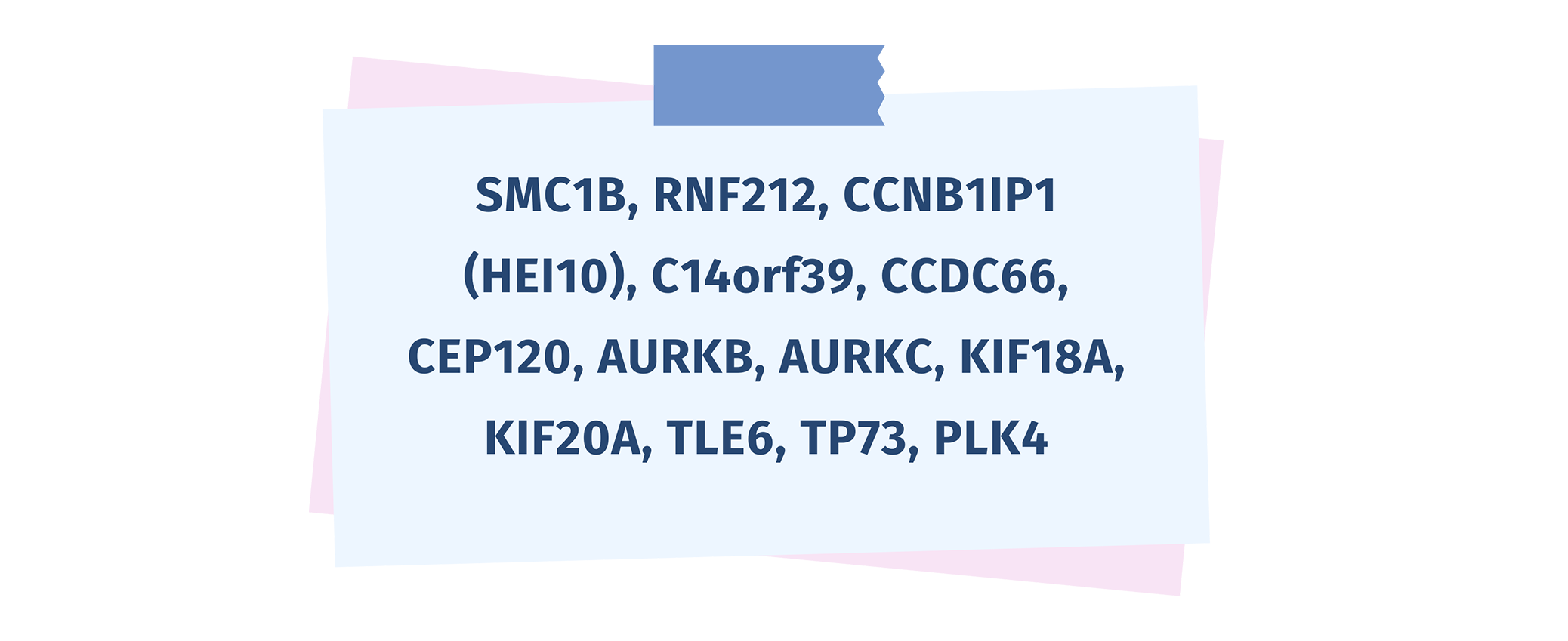
Overall, the analyzed genes fall into three major functional areas:
 meiotic cohesion and recombination
(key determinants of non-disjunction risk);

segregation and checkpoint control
(relevant in both meiosis and mitosis);

centrosome function and spindle dynamics
(relevant to early mitotic errors and complex/mosaic patterns).
1.Carioscia et al. 2026 Common variation in meiosis genes shapes human recombination and aneuploidy Nature 2026 Jan 21. doi: 10.1038/s41586-025-09964-2.
2.Sun et al. 2023 Identifying risk variants for embryo aneuploidy using ultra-low coverage whole-genome sequencing from preimplantation genetic testing. Am. J. Hum Genet 2023; 110:2092-2102
3.Tyc et al, 2020 Exome sequencing links CEP120 mutation to maternally derived aneuploid conception risk. Hum Reprod. 2020 9;35:2134–2148.
4.Nguyen et al. 2017 Identification and characterization of Aurora kinase B and C variants associated with maternal aneuploidy. Mol Hum Reprod 2017 13;23:406–416.
5.Biswas, et al. 2024 Maternal genetic variants in kinesin motor domains prematurely increase egg aneuploidy, Proc. Natl. Acad. Sci. U.S.A.(2024) 121 (45) e2414963121.
6.Lledo et al. 2023 Identification of novel candidate genes associated with meiotic aneuploidy in human embryos by whole‑exome sequencing. J Assist Reprod Genet . 2023;40:1755-1763.
7.McCoy et al. 2015 Common variants spanning PLK4 are associated with mitotic-origin aneuploidy in human embryos. Science. 2015 10;348:235–238.
Test results

Positive: pathogenic variant detected
The presence of rare variants with plausible functional impact in genes involved in meiosis/mitosis may indicate a predisposition to producing embryos with aneuploidies. Interpretation should always be integrated with clinical data and, when appropriate, with genetic counseling.

Negative: no pathogenic variant detected
No variants associated with an increased risk of producing embryos with chromosomal aneuploidies are identified. A negative result does not exclude aneuploidy risk, as the phenomenon is multifactorial and depends also on maternal age and other biological variables not investigated by the test.
Test indications
The test may be considered when investigating a possible genetic contribution to an increased aneuploidy risk in scenarios such as:

repeated ART/IVF cycles with a high proportion of aneuploid embryos, especially if unexpected for maternal age;
recurrent implantation failure or recurrent pregnancy loss, particularly when there are data suggestive of a chromosomal origin;
a previous conception/pregnancy affected by chromosomal aneuploidy;
the need for a preconception or pre-IVF assessment to clarify possible genetic contributors;
the presence of patterns suggestive of mitotic errors (e.g., "chaotic" patterns, suspected tripolarity) or meiotic errors (recurrent aneuploidies consistent with non-disjunction).

Turnaround time:

brochure

Request information about FERTILADVANCE ANEUPLOIDY RISK test
Fill out this form for a free consultation. One of our geneticists will contact you, free of charge and with no obligation, to provide you with all the information you need.